
upcoming…
My work can be seen on a regular rotating basis as a juried gallery member at the historic Desert Art Center in Palm Springs. The next exhibition opens on October 2, with reception from 5-7 pm. Gallery open 10am-4pm, 7 days a week. 550 N. Palm Canyon Drive, Palm Springs, CA 92262.
Tlaquepaque
September 10, 2026
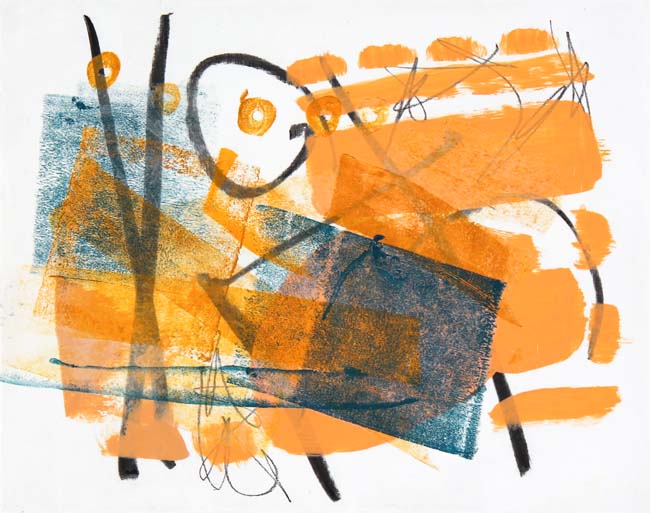
Tlaquepaque
Acrylic, charcoal, paper on wood panel. 11 x 14 in. 2026.
No, I have never been to Tlaquepaque. But, my god, you’ve got to love that word! The things it does in your mouth, with your teeth, with your tongue! It’s a trip down the road, and a dance, and a party, and you can’t say it without smiling, I think – the oral contortions demand it.
Threads of Mexico weave all through California, and all through my California self. The Mexico of mariachis and fantasy fiesta. The Mexico of my sister making me chilaquiles that she learned from her landlady in San Juan Tuxtla, and the Mexico of fandangos she danced south of Veracruz. The Mexico of the kitchen brooms made by her campesino friends who crafted tinkling jaranas in their spare time. The Mexico of ancient Toltec ceramics and stonework and complex terrifying deities that look like they’ll eat you. The Mexico of the neighbors next door, of lifelong friends, of the names of half the streets I’ve lived on and half the cities I’ve lived in, of half of what’s made my life worth living. Of the sounds and flavors that have punctuated and sweetened my life.
The Mexico of Alma, the street I grew up on; Alma, the first school I went to; Alma, my little friend up the street and her sister Henrietta, both with a single long dark braid down their backs and with so many brothers and sisters, all sleeping in a room up a ladder in a little house of warmth and smiles and good smells. The Mexico of the Silvas’s, who tucked my brother and me in their prominent pew at St. Stephen’s and sponsored us for our confirmations, whose older son was away in a place called Vietnam before we had ever heard of it, and who tracked his whereabouts with pins on a map on the dining room wall.
And the Mexico of the “Teocalli”, for some reason the name of my high school annual; and of Joe and Josephine Aztec, our school mascot, a role which was taken over by proud Chicano students halfway through my time there, the time of the East L.A. Chicano Moratorium and the Brown Berets. They transformed that school.
And so it all tumbles out together in Tlaquepaque, fierce and colorful, powerful and dancing, picante and sweet, companions in my life.
Read more posts on the Magicgroove blog —>
Portfolio:
paint
sand
homesteads